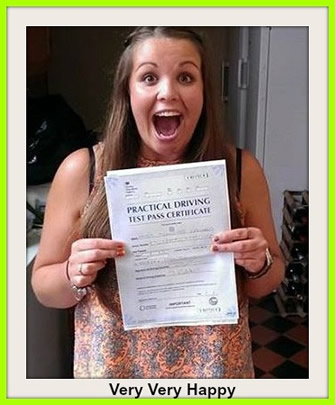
How It Feels To Pass Your Driving Test!
 A Very Happy Bunny...
|
Ricardo Pinto
 No driver faults...
|
Daniel Cunningham
 1st Time Pass...
|
Luke Walker
 ...
|
David Machin
 Another 1st Time Pass....
|
Keelan Loach
 1st Time Pass!...
|
Katherine Rogers
 Another 1st time Pass...
|
James Browne
 ...
|
George Postle
 Yet Another 1st Time Pass...
|
Hannah Wells
 Another 1st Time Pass...
|
Lucy Jeffries
 1st Time Pass...
|
Adina Petruscu
 Passed at 1st attempt with Lytes...
|
Rebecca Grey
 Another 1st Time Pass...
|
James Tomlinson
 Another 1st time pass...
|
Hoby Brathwait
 Passed at 1st Attempt With Lytes...
|
Amy Yaxley
 1 Time Pass...
|
Dean Coutts
 1st Time Pass...
|
Keegan Collington
 Another 1st Time Pass...
|
Tamta Maisuradze
 ...
|
Ben Galbraithe
 Passed at 1st Attempt With Lytes...
|
Charlotte Handley
 Another 1st Time Pass...
|
Jeniffer Edwards
 Another 1st Time Pass...
|
Nicola Mian
 Another 1st Time Pass...
|
Tom Johnson
 ...
|
Peter Rose
 ...
|
Nicole Giglia
 Another 1st Time Pass....
|
Larissa Postolan
 Another 1st Time Pass!...
|
Emma Dawson
 Another 1st Time Pass...
|
Minal Popat
 Another 1st time Pass....
|
Alastair Cooke
 ...
|
Mohammed Bardouz
 Another 1st time Pass...
|
Tom Bowlay
 Another 1st Time Pass!...
|
Claire Garnett
 Another 1st Time Pass....
|
Anna Earp
 Another 1st time Pass!...
|
Connor guiness-Smith
 Another 1st Time Pass...
|
Katie Byres
 Yet Another 1st time Pass!...
|
Ryan Daws
 Another 1st Time pass...
|
Daniel Yeates
 1st Time Pass...
|
Chris Dack
 1st Time Pass. NO DRIVER FAULTS!...
|
Ben Morris
 Swindon...
|
Carl Johnson
 Another 1st Time pass...
|
Mitchell Dodson
 Another 1st Time pass...
|
Zach Simons
 ...
|
Manisha Chaggar
 ...
|
Peter Sturgess
 Another 1st Time pass...
|
Danielle Miller
 Another 1st Time pass...
|
Freja Stadler
 Another 1st Time pass...
|
Leroy Dacosta
 ...
|
Sophie Dumbrill
 ...
|
Millie Poyser
 Another 1st Time pass...
|
David Baird
 1st Time Pass....
|
Michaella Wilkinson
 1st time Pass....
|
Mohamed
 1st time pass....
|
Julia Giibin
 1st Time pass...
|
Congratulations to Hannah
 ...
|
|
Free Advice
This Site in daily development, please check back soon.
| Should I Use Sun Cream When Driving | | | Driving Lessons Swindon ask, “Should I use sun cream when driving?”
We know we ought to protect ourselves from the sun when out and about, but does the car provide adequate protection? Research shows that more skin problems and cancers occur on the face and arms on the right side of the driver (the other side in countries who think its correct to drive on the wrong side of the road). Also, more advanced ageing occurs on that side. This effect builds up over time. UV rays are graded as to wavelength. UVC is blocked by the atmosphere and is very damaging. UVA and UVB both do damage in different ways. Some car windows do have a degree of UV protection built in, but how much? I guess they vary and this is probably a technical field on its own. However, as regular road users we need some basic advice. It seems that windscreens provide more protection than the side windows because they are laminated. This means they have a sheet of plastic sandwiched in the glass. Plastic is dramatically affected by UV so protection is built in. The side windows are not always laminated so may not have this protection built in. Therefore, your car is not necessarily protecting you. However, this protection in not predominately there for our good health but to shield the laminate from sun damage and will not usually block out all harmful rays. The manual of your car or the manufacturer will be able to guide you further.
So to answer our question “Should I use sun cream when driving” The answer is a big YES.
Our advice is
1 Use a sun cream of at least factor 30.
2 Wear long sleeves.
3 Keep the windows up.
4 Wear sunglasses with UVA and UVB protection
5 Wear a hat.
| | | |
|
| |
| Winter Driving | | |  Winter Driving Winter Driving
There is no doubt that driving in winter can be challenging and potentially hazardous. However, with a little preparation you can reduce the risks dramatically.
We hope you will find some of the advice below of help.
The Highway Codes states that you must defrost and demist all windows before setting off. Clearing just a brick sized view hole in the windscreen is dangerous (I’m sure we have all seen someone do it).
A word of caution, If you leave your vehicle running and un-attended whilst demisting and it is stolen, your insurance company may not pay out as it may not be considered reasonable care of the vehicle.
Ensure you vehicles engine anti-freeze is up to the job. It needs changing periodically. Your local garage can easily test its effectiveness.
Ensure that you have sufficient high quality screen-wash in your washer bottle. You need to ensure this is capable of not freezing until -15 degrees Centigrade or below. The pipes that deliver the screen-wash to the nozzles are very thin and the screen-wash can easily freeze inside rendering the facility useless. I only use a concentrated screen-wash not the ready mixed type. That way I can control the mixture strength. In summer I may only have a 20% mix but in winter I may go up to 100%. Obviously follow the manufacturer’s instructions for the screen-wash and your vehicle.
Ensure your vehicle is properly maintained.
Consider buying winter tyres. Standard tyres are far less effective in low temperatures. Winter tyres are designed to work in temperatures below about +8 degrees Centigrade. Yes it’s more expense but it’s cheaper than an accident.
Make sure that the windscreen wipers are switched off before turning the ignition on. If the wipers are stuck to the screen the load could cause the fuse to blow or damage the linkage.
Check that all lights are working, clean and clear of snow.
Only ever use cold or tepid water to defrost the windscreen. Hot water may cause thermal shock and crack the screen.
Consider carrying a winter kit. Extra clothes in case of breakdown, a torch, shovel, towrope, sunglasses, mobile phone and 12v mobile phone charger, and maybe some old carpet or car mats to put under the wheels if you get stuck. Take out vehicle breakdown cover. Take a drink and a snack.
Listen to weather forecasts and try to make your journey before the bad weather sets in if possible.
In slippery conditions consider using 2nd gear to move away as it may afford greater traction.
Change up to a higher gear but keep the revs and your speed down.
Remember stopping distances can be up to 10 times longer on ice (much longer if downhill)
Switching off the vehicles traction control allows the wheels to spin. This sometimes helps moving away as the friction can melt the ice. But remember to switch it back on again as soon as you have moved away.
Keep your speed down.
Fresh snow offers more grip than compacted snow or ice.
Read your vehicle’s manual and understand how its Anti-lock Braking System works (ABS). ABS is NOT there to reduce braking distance. Its purpose is to stop the wheels from locking up so that you can still steer. You cannot switch ABS off.
Plan well ahead and operate all the controls gently and smoothly.
Should the car skid ease off the gas pedal and steer towards the skid.
If you ever get the chance practice skid control in a quiet car park.
| | | |
|
| |
|
|